

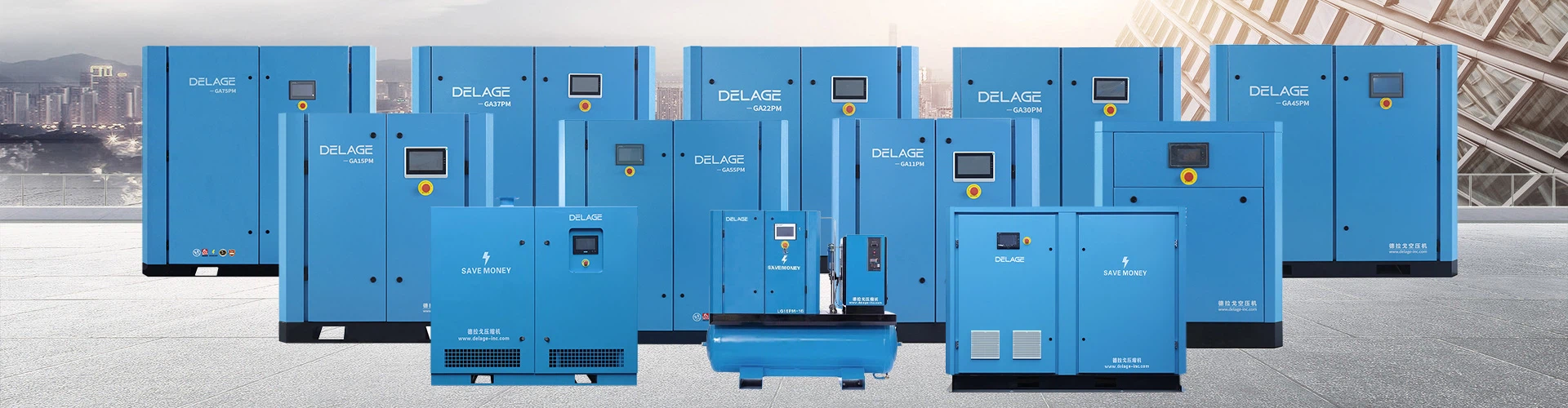


1. Simple and compact structure: The oil-free pump is composed of screw, pump body, end cover, seals and other components with opposite rotation direction, and the structure is very simple;
2. Dry operation does not require any working medium, so there is no oil pollution, no sewage discharge, and significant energy saving and emission reduction effects;
3. The original parts of the air extraction chamber are friction-free: there is a certain gap between the screw and the pump body;
4. High vacuum degree: a single screw dry vacuum pump can replace the three-stage Roots pump water ring vacuum unit;
5. Low noise: generally around 80 decibels;
6. Oilless pump are suitable for pumping condensable gases (such as water vapor, etc.) and dust-containing gases;
7. Pumping from the atmosphere to the ultimate pressure of 5Pa can be solved with just one pump;
8. Dry operation makes recovery of lytic enzyme easier;
9. Can be combined with a Roots pump to form a vacuum system to obtain higher ultimate vacuum and increase pumping speed;
Oilless Pump parameter table
|
Model |
ultimate pressure |
Rated pumping speed |
rated power |
Noise |
weight |
Installation dimensions (mm) |
air intake |
exhaust vent |
||
|
KPa.A |
m³/h |
KW |
dB |
kg |
long |
Width |
high |
DN |
DN |
|
|
SUP-11PM |
20 |
700 |
11 |
75 |
1300 |
1500 |
1100 |
1400 |
80 |
65 |
|
SUP-15PM |
20 |
900 |
15 |
76 |
1300 |
1600 |
1150 |
1500 |
80 |
65 |
|
SUP-22PM |
20 |
1500 |
22 |
77 |
1500 |
100 |
80 |
|||
|
SUP-37PM |
20 |
2500 |
37 |
80 |
1800 |
1960 |
1300 |
1690 |
150 |
100 |
Introduction to Oilless Pump accessories: performance characteristics
Oxidation stability: It is not easy to deteriorate even if it is in direct contact with air, resin, chemical raw materials, etc. under high temperature conditions for a long time, reducing the formation of harmful paint films and grease, and providing a longer oil change cycle.
Anti-rust and anti-corrosion: It can form a very effective anti-corrosion film on the metal surface, thus comprehensively preventing system corrosion caused by inhalation of corrosive gases and moisture.
It can quickly separate the water entrained in the oil to achieve the required vacuum degree.
It has a lower vapor pressure to prevent oil from flowing back and spreading from the inner cavity of the pump to the vacuum system, causing oil backflow. This ensures sufficient ultimate vacuum.
Filter element: used to filter gas and oil in the vacuum pump to keep the vacuum pump clean and running normally.
The filter element separates solid particles in liquid or gas, or fully contacts different material components to speed up the reaction time, which can protect the normal operation of the equipment or the cleanliness of the air. When the fluid enters the filter element equipped with a certain specification filter, its impurities are blocked , and the clean flow flows out through the filter element. The liquid filter element allows liquids (including oil, water, etc.) to be cleaned to the state required for production and life, that is, the liquid reaches a certain degree of cleanliness.

Water cooler: used to cool the vacuum pump to prevent overheating and damage.
Water cooler is a type of condenser commonly used in vacuum tower top vacuum systems. Since the temperature of circulating water for cooling is usually 30~32°C, conventional water coolers (arbow baffles, floating head type) have minimum temperature difference limitations for cross-heat transfer. When the temperature after cooling reaches below 40°C, the temperature of the circulating water If the riser is too small, the consumption of circulating water will be too large, so it has been rarely used in recent years.

Vacuum pump valve: used to control the flow of gas and liquid and maintain the pressure of the vacuum pump.
Vacuum valve refers to a vacuum system component used in a vacuum system to change the direction of air flow, adjust the amount of air flow, and cut off or connect pipelines. Vacuum valve closing parts are sealed with rubber sealing rings or metal sealing rings.

Vacuum pump connector: used to connect the vacuum pump and other equipment or pipes.

Vacuum gauge: used to measure the pressure inside the vacuum pump to ensure normal operation of the vacuum pump.
Vacuum Gauge, also known as vacuum gauge, is an instrument for measuring vacuum or air pressure. Generally, the changes in certain physical effects of gases under different pressures are used to measure air pressure. It is widely used in scientific research and industrial production.

Vacuum pump controller: used to control the start, stop and operating mode of the vacuum pump.
The vacuum pump intelligent controller is a mechanical device used to automatically detect the working status of the power supply of multiple oil dispensers and start and stop the vacuum pump accordingly.

Vacuum pump seal: used to seal the internal and external interfaces of the vacuum pump to avoid gas leakage.
Its advantages include good sealing, good resistance to gases and liquids, and suitable for use under high temperature and high pressure conditions. However, the disadvantage of rubber sealing materials is that they age easily and need to be replaced regularly.

Vacuum pump mounting bracket: used to fix the vacuum pump to ensure its stability and safety.
The above are some common vacuum pump accessories. Different types of vacuum pumps may require different accessories.

An oil-free vacuum pump is a mechanical vacuum pump that can operate without any oil for lubrication.
Advantages and Disadvantages
It has the advantages of simple structure, easy operation, convenient maintenance, and will not pollute the environment. The oil-free vacuum pump has good durability and is a dual-purpose vacuum pump for vacuuming and compression. It is a basic equipment for obtaining vacuum with a very wide range of applications.
Compared with oil pumps, oil-free vacuum pumps have lower vacuum degree and smaller air pumping capacity, but they are small in size, easy to install, simple to maintain, easy to move, do not produce oil smoke, and do not pollute the environment. They are especially suitable for use in laboratories with higher requirements. It is also one of the most commonly prepared equipment in the laboratory.
Therefore, when purchasing an oil-free vacuum pump, you must first determine the required working vacuum degree. If the required degree of vacuum is high, the selected vacuum pump must be higher than the required vacuum degree. Otherwise, the vacuuming requirements will not be met. to job requirements. The second is the pumping rate of the oil-free vacuum pump. When selecting the pump, it should be slightly larger than the required pumping rate, so that it can better meet the needs. Finally, check whether the extracted gas is corrosive. Corrosive gas will corrode the pump, so special materials must be used to meet the needs.
working principle
Its working principle is the same as that of a general positive displacement pump, and it is composed of stator, rotor, rotary vane, cylinder, motor and other main parts. The rotor with rotary vanes is installed eccentrically in the fixed cylinder. When the rotor rotates at high speed, the four radially sliding vanes in the rotor slot divide the pump chamber into four working chambers. Due to the centrifugal force, the rotary vanes are closely attached to the The cylinder wall separates the stator's inlet and outlet, and operates over and over again to change its volume. The inhaled gas is discharged from the exhaust port, thereby achieving the purpose of air extraction.
Hot Tags: oilless pump, China oilless pump manufacturers, suppliers, factory, Oil Free Vacuum Pump, Oilless Pump, Oilless Vacuum Pump, Oil Free Pump, Vacuum Pump, Oil Free High Vacuum Pump


