

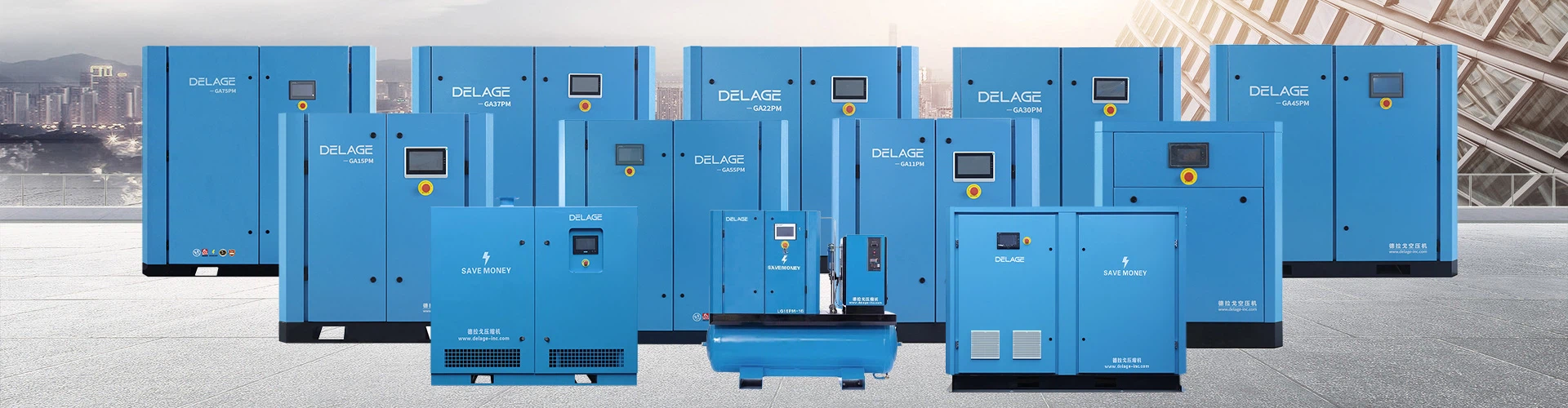
Centrifugal Air Compressor
Why Choose Us
Our Certificate
The company has passed ISO9001, ISO14001, and ISO45001 international quality management system certifications, and its products have passed the testing of third-party testing agencies certified by GCCA.
Professional team
The company has an independent R&D design department and team, and has established a provincial R&D center energy efficiency testing laboratory. R&D personnel account for more than 15% of the total staff, responsible for product development and process technology guidance.
Quality Control
We design and develop specific products according to the specific needs of our customers. Before products are delivered to customers, we strictly conduct quality testing and controls to ensure product quality is stable, reliable, and energy-saving.
Our Services
The company actively provides technical consultation and answers, and quickly provides customers with corresponding product quotations to ensure that customers have a more comprehensive understanding of the company's products and receive the best service attitude.
A centrifugal compressor is a type of compressor that uses centrifugal force to pump fluid. The fluid is pushed radially outward from the center of the impeller, and the centrifugal force causes the fluid to compress.Centrifugal air compressors supply compressed air for various manufacturing processes in industrial factories. These machines convert atmospheric air to a higher pressure through the use of a high-speed rotating impeller and radial blades that, in simple terms, accelerate air molecules and then cram them together, thus creating an increase in pressure.


Benefits of Centrifugal Air Compressor
Efficiency
If you're thinking of purchasing a centrifugal air compressor, what are some of its benefits? Well, a centrifugal air compressor is a dynamic machine that has numerous advantages over conventional rotary screw compressors. They are oil-free, meaning cleaning air and reduced maintenance costs. They operate by creating air pressure through rotating disks (impellers) and a diffuser plate that has the ability to convert velocity energy to pressure energy. This system compresses air in multiple stages. Multiple stages increase the efficiency of the compression process, allows for better heat transfer to cool the air, and helps the compressor perform at differing part loads while maintaining its performance benchmark.
Reliability
Centrifugal air compressors can run continuously for long periods of time, and that's one of their main strengths. It's no wonder they're commonly found in large manufacturing plants. Able to handle large flow rates at varying pressures, they're consistent, reliable, and efficient machines that don't sacrifice efficiency at part loads. If controlled correctly they are the best choice of compressor pound for pound. They're compact, too, so they don't take up as much floor space as multiple screw compressors to make up the difference.
Low Maintenance
Do you need equipment that produces a constant flow of high-pressured air that'll meet high demands? Then the centrifugal air compressor is a good choice. Utilizing oil-free compressed air, this type of compressor has a limited few wearing parts so there's not a lot of need for maintenance. Centrifugal compressors require less maintenance intervals. There's no cost for an oil change because they are oil free and overall, less consumables compared to their counterparts. These compressors tend last a very long time, we still encounter compressors built in the early 1980's still running today.
What are the Applications of Centrifugal Air Compressor
Industrial use
The centrifugal air compressor is more widely used for industrial applications and for this reason the centrifugal compressor is also known as “Petroleum and Chemical Air Compressors for Industry” or chemical air compressor for the industry. More specifically, this petroleum and chemical air compressor for the industry is used for the following.
Air separation
The ordinary atmospheric air is ~78% nitrogen and ~21% oxygen, with the remaining ~1% being made up of argon, carbon dioxide and trace amounts of other gases. These gases are needed in many industrial areas and can be obtained by an air separation process.
Oil refining
The petroleum and chemical air compressors for the industry is widely used at oil and gas refineries: the centrifugal compressors in oil & gas deliver high horsepower for the most demanding, high-pressure operations.Chemical industry-In recent decades, petroleum and chemical air compressors for Industry are more and more widely used in the chemical process industries (CPI).
Types of Centrifugal Air Compressor
Single Stage Centrifugal Compressor
With the improvement of the quality of current oil-free air compressors, the quality of single-stage centrifugal compressors has been fundamentally improved, and it can fully meet the needs of modern industrial production. Its advantages in the use of completely oil-free air compressors be reflected.
Rotary Centrifugal Compressor
The rotary centrifugal compressor uses an impeller to drive the gas to rotate at high speed, causing the gas to generate centrifugal force. Due to the expansion flow of the gas in the impeller, the flow rate and pressure of the gas after passing through the impeller are increased, and compressed air is continuously produced.

Air is drawn into the center of a rotating impeller with radial blades and is pushed toward the center by centrifugal force. This radial movement of air results in a pressure rise and the generation of kinetic energy. Before the air is led into the center of the impeller, the kinetic energy is also converted into pressure by passing through a diffuser and volute.
Each stage takes up a part of the overall pressure rise of the compressor unit. Depending on the pressure required for the application, a number of stages can be arranged in a series to achieve a higher pressure. This type of multi-stage application is often used in the oil and gas and process industries. Alternately, in wastewater treatment plants, low pressure, single-stage applications are used to achieve the desired pressure ratio.
In modern configurations of centrifugal air compressors, ultra-high speed electric motors are used to drive the impellers. This results in a compact compressor without a gearbox and associated oil-lubrication system, thus making it oil-free and appropriate for applications that require 100 percent oil-free air.
Impeller
The rotating element of the centrifugal compressor, responsible for imparting kinetic energy to the gas and accelerating it outward towards the periphery.
Diffuser
The high-speed gas enters the diffuser after leaving the impeller, so that it converts the high-velocity gas into high-pressure gas by reducing its velocity and increasing its pressure.
Volute or scroll
A curved, stationary casing surrounding the impeller and diffuser, which collects the high-pressure gas from the diffuser and directs it to the compressor outlet.
Inlet Guide Vanes (IGV) or Inlet Diffuser
An optional component, it is in charge of controlling the flow of gas entering the impeller, improving the compressor's efficiency across different operating conditions.
Bearing and shaft
While the impeller is connected to the compressor's shaft, it transfers the rotational energy from the driver to the impeller. Bearings support the shaft and allow it to rotate smoothly.
Seals
These are used to prevent gas leakages between the rotating and stationary components. The labyrinth seals are commonly found.Cooling and lubrication system: the first is crucial to maintain optimal operating temperatures, while the latter ensures that bearings and other rotating parts are properly lubricated to reduce friction and wear.
Driver
In charge of providing the mechanical power to rotate the impeller, they can be electric motors, steam turbines, gas turbines, internal combustion engines…
Casing
The outermost pressure containing part
Balance drum
Its role is to balance the pressure on both discharge and suction sides
Coupling
In charge to transmit power from driver to compressor
How to Choose Centrifugal Air Compressor
Determine the Application
Understand the purpose of the compressor and the specific tasks it will be performing. Is it for industrial use, construction, automotive, or personal use? Different applications may require different types of compressors.
Consider Air Volume and Pressure Requirements
Determine the required air volume (measured in cubic feet per minute or CFM) and pressure (measured in pounds per square inch or PSI) for your application. This information will help you identify the capacity and power of the compressor you need.
Select the Compressor Type
There are several types of compressors available, each with its own advantages and suitable applications.
Consider Power Source
Determine the available power source for the compressor. Compressors can be electrically powered or run on gasoline, diesel, or other fuels. Ensure that the power source matches your application's requirements and available resources.
Evaluate Features and Accessories
Consider additional features and accessories that may be required for your application. These can include air dryers, filters, tanks, control systems, and safety features. Choose a compressor that offers the necessary features and can be easily integrated into your existing setup.
Assess Maintenance Requirements
Consider the maintenance needs of the compressor, including regular servicing, oil changes, and filter replacements. Some compressors require more maintenance than others, so evaluate the ongoing maintenance costs and efforts associated with each type.
High Efficiency
Centrifugal compressors offer high energy efficiency, reducing costs.
Compact Design
These compressors have a compact footprint, allowing for space-saving installation in various industrial settings.
Continuous Operation
Centrifugal compressors can operate continuously without the need for frequent start-stop cycles, ensuring a consistent supply of compressed air.
Low Maintenance
With fewer moving parts and simplified design, centrifugal compressors require minimal maintenance and have longer service intervals.
Quiet Operation
Compared to reciprocating compressors, centrifugal compressors produce less noise and vibration during operation, contributing to a quieter work environment.

Intake Filter
The air filter is changed every year. This period may be less if the atmospheric conditions are dusty.
Control Panel
The process of control panel checkout is designed to know if the control panel is fully functional. Make sure that you are regularly checking the control panel.The instruction manual that comes along with the centrifugal compressor includes the instructions to help you with the adjustments.
Checking Vibrations
You need to monitor the vibrations on the shaft on both the side by using a vibration analyzer.If the vibration level is more than 2 mils on 3000-3600 RPM and 2.5 mils on 1500-1800 RPM drivers. And in case you are using a non-contacting prob, consider an additional 0.5 mils as the recommended value.However, read the instructions on the manual to know exact values for your model.
Discharge Check Valve
In order to inspect the discharge check valve, you need to remove it from the compressed air system.Make sure that you look for any signs of broke strings, corrosion, freedom of movement, and damaged seals.Immediately have the affected part repaired or replaced as needed.
Oil Filter
Oil filters have filter elements that must be replaced every year. If the pressure has exceeded 8 PSI from the pressure limits when the filter was new, it is also time to replace the filters.Discard the filter elements when you are replacing the oil filter.Clean all other parts properly and then lubricate the rubber seals that will come with the new filters.
Oil Cooler
In order to inspect the oil coolers, you will have to remove the bonnets.Check the zinc anode and look for signs of oxide deposits and erosion. But don’t want for it to be completely eroded. Change it while it is eroded for more than half. And to clean the shell side of the oil cooler, flush a stream of water at high velocity through the cooler.
Condensate Traps
Check for any signs of irregular discharge every now and then to ensure that everything related to the condensate traps is fine.A fully-functional condensate trap should have either a semi-continuous discharge, intermittent discharge, or a constant discharge.In case you don’t find any discharge, you need to open the condensate bypass valve to find out the issue. If there is a large deposit of condensate discharge, then it is time for an immediate repair or replacement.
Our Factory
Zhejiang Delage Machinery Compressor Co., Ltd. (referred to as "Delage Machinery" or "Delage Air Compressor") was established in 2013 and is located at No. 1, Gongqu District 1, Chang'an Town, Haining, Jiaxing City, Zhejiang Province (close to Hangzhou and Shanghai), covering an area of approximately 6,398 square meters, and has built a standardized factory building of approximately 15,000 square meters.The company is mainly engaged in the manufacturing and processing of air compressors, power savers and accessories; the wholesale of air compressors and supporting equipment, energy-saving products and supporting equipment, Wujinjiaodian, building decoration materials, plumbing equipment, filtration and purification equipment and accessories, lubricating oil, Retail; repair, maintenance, and leasing services of air compressor equipment and supporting equipment, energy-saving products and supporting equipment; technology development, technical consultation, technology transfer, and technical services in the field of energy saving; engaged in the import and export business of various commodities and technologies (National Except for those restricted or prohibited; except for those involving pre-approval), etc. Products have been widely used in textile, medicine, aerospace, cement, food and other industries.
Our Certificates


FAQ
Q: Why choose centrifugal compressor?
Q: What are the failure modes of centrifugal compressor?
Q: How do you control the capacity of a centrifugal compressor?
Centrifugal compressor capacities can be controlled by causing the compressor to move back on its characteristic curve. This is generally accomplished by throttling the discharge valve.
Q: What is the preventive maintenance of a centrifugal compressor?
Q: Can a centrifugal compressor be serviced?
Q: What is the principle of centrifugal compressor?
Q: Do centrifugal compressors need oil?
Q: What is the maximum capacity of a centrifugal compressor?
Q: What is the maximum pressure for a centrifugal air compressor?
Q: What is the maximum efficiency of centrifugal compressor?
Q: Where is the centrifugal compressor mostly suitable?
Q: How does a centrifugal compressor increase pressure?
Q: What is the life expectancy of a centrifugal compressor?
Q: How are centrifugal compressors lubricated?
Q: Can a centrifugal compressor stall?
Q: What is the most common application of a centrifugal compressor?
Q: What is happening when a centrifugal compressor is surging?
Q: How does the air flow through the centrifugal compressor?
Q: What are the inlet losses in a centrifugal compressor?
Q: Why choose centrifugal compressor?
We're professional centrifugal air compressor manufacturers and suppliers in China, specialized in providing high quality custom service. We warmly welcome you to wholesale high-grade centrifugal air compressor made in China here from our factory.
Single Stage Centrifugal Compressor, Centrifugal Air Compressor, Axial Compressor And Centrifugal Compressor