

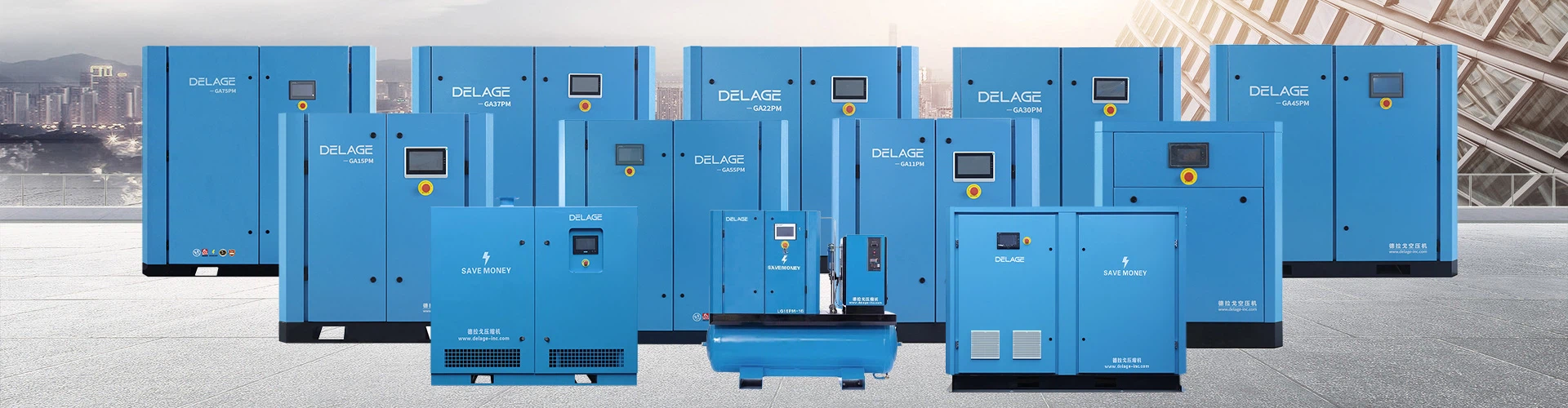
Rotary Screw Air Compressor
Why Choose Us
Our Certificate
The company has passed ISO9001, ISO14001, and ISO45001 international quality management system certifications, and its products have passed the testing of third-party testing agencies certified by GCCA.
Professional team
The company has an independent R&D design department and team, and has established a provincial R&D center energy efficiency testing laboratory. R&D personnel account for more than 15% of the total staff, responsible for product development and process technology guidance.
Quality Control
We design and develop specific products according to the specific needs of our customers. Before products are delivered to customers, we strictly conduct quality testing and controls to ensure product quality is stable, reliable, and energy-saving.
Our Services
The company actively provides technical consultation and answers, and quickly provides customers with corresponding product quotations to ensure that customers have a more comprehensive understanding of the company's products and receive the best service attitude.
A rotary-screw compressor is a type of gas compressor, such as an air compressor, that uses a rotary-type positive-displacement mechanism. These compressors are common in industrial applications and replace more traditional piston compressors where larger volumes of compressed gas are needed, e.g. for large refrigeration cycles such as chillers, or for compressed air systems to operate air-driven tools such as jackhammers and impact wrenches. For smaller rotor sizes the inherent leakage in the rotors becomes much more significant, leading to this type of mechanism being less suitable for smaller compressors than piston compressors.


Safe and Convenient
Rotary screw air compressors are incredibly convenient, given that they deliver air continuously for the required purposes. They are also safe, and cases of accidents with the machines are almost unheard of.
Functions at extreme weather conditions
Rotary air compressors can work at high temperatures or in low conditions to your convenience. The machines can also work in areas where other forms of energy are prohibited due to safety or temperatures levels. Our rotary screw compressors run continuously, and this continuous duty function means that the rotary screw compressor can run all day, in all conditions without wearing out crucial components of the machine.
They are designed to run tools that generate more power that typical equipment
And since their air flow rates are extremely high, rotary air compressors can power such equipment effectively.
They are easier to maintain
Many of the modern air compressors in the market have fewer parts that require maintenance. In fact, some rotary screw machines have up to 70% less of parts, which in turn lowers maintenance costs dramatically. Although easier to maintain, they do still need maintenance and as long as you keep with a rotary screw maintenance schedule, you will likely be rewarded with many years of optimal productivity from your machine.
They run quietly despite their massive air flow
Rotary screw air compressors are generally quiet performers, with many of them having noise dampening technologies. That and the fact that they are not huge in size makes them convenient to be stored anywhere and till provide a safe working environment. Many rotary screw compressors are barely louder than a dishwasher, so you can still have conversations in your compressor room, and not feel like you have to yell over the noise.
They are good energy conservers
Rotary screw machines are generally energy efficient, and they generate less heat than normal air compressors.
They consume less oil than other oil flooded air compressors.
In addition, they have minimum oil carryovers. Our rotary screw compressors do an exceptional job of sealing in the lubricating oil, which means that your workshop or compressor room will be drier, cleaner, and suitable to situations that demand low air moisture.
They are designed to last
Rotary screw air compressors are designed to serve you for many years, all along while having little or no capacity reduction.

Construction
At construction sites, workers require a suitable source of compressed air to power tools such as drills, hammers, and nail guns. However, stationary air compressors are not installed at the construction site, which is why portable air compressors are quickly brought in to fulfill the usage needs.In particular, construction projects often involve changing locations throughout the week, and a portable air compressor can conveniently be taken to any job site.
Production
While many manufacturing facilities have large stationary air compressors installed, a few of them will have prepared the use of portable air compressors as backup equipment. Most portable air compressors run on fuel, making them excellent to carry in case of power loss or electrical emergencies. This ensures smooth production operations and high efficiency in the workplace.
Agriculture
Farming is a labor-intensive job that requires attention, care, and consistent strength to achieve the best results. Whether they are spraying crops or operating dairy farming equipment, many farmers benefit from using portable air compressors that they can take to any location on their vast land.
Oil and Gas
In the oil and gas industry, workers rely on portable air compressors to provide power to equipment at various onshore and offshore drilling locations. They also depend on machinery to install heat exchangers, control cooling fluids, and pneumatic valve circuits.
Pharmaceuticals
The pharmaceutical industry relies on air compressors for packaging products, operating conveyor systems during production, spray coating, and supplying compressed air to mixing tanks.Pharmaceutical companies require compressed air for daily operations. The benefits of using a portable air compressor come into play if the facility is particularly large and requires multiple devices in different rooms for well-organized processes. Additionally, similar to many manufacturing companies, they may use a portable air compressor as a backup solution for conventional compressors.
Types of Rotary Screw Air Compressor
Two-stage Compressors
Two-stage lubricated rotaries compress air in two steps. Step or stage one takes atmospheric air and compresses it part way to the discharge pressure target. Step or stage two ingests the air at the inter-stage pressure and compresses it to the discharge pressure target. Compression in two stages improves efficiency, but adds cost and complexity given the additional rotors, iron and other componentry involved. Two-stage is generally offered in the higher HP ranges (100 to 500 HP) because the improved efficiencies result in larger dollar savings when air use is large.
Single-stage Compressors
Single stage versus two-stage, it is a relatively straightforward calculation to determine what the payback will be from the more efficient but more costly two-stage unit.
Remember that the energy cost of operating a compressor is the largest expense over time, so evaluation of a two-stage machine is certainly worth a look.
Lubricated Compressors
The lubricated rotary screw compressor has been the most popular technology for the majority of industrial plant air applications from 20 to 500 HP and from 80-175 PSIG. These compressors offer unmatched versatility and adaptability to various operational demands. Their efficient design ensures a continuous and reliable supply of compressed air, crucial for sustaining seamless production processes.
Components of Rotary Screw Air Compressor
Rotary screw element
Interlocking twin rotors are placed inside lined cylinders wherein their complementary and circulatory rotations occur. As soon as the machine is switched on, rotors will operate, receiving suctioned air from the opening valve. Connected to the compressor's motors, rotors will start spinning through a wide distribution system of belts, bearings, and the motor drive. Air is sucked and compressed between the rotors while the spinning continues.
Inlet air filter
These are required for regulatory maintenance and an important component of a compressor. When it comes to oil-injected units, the air filters clean up moisture and oil residue from the opening valve and cooling injection processes. Regular inspection of air filters is crucial for your equipment's performance.
Oil filter
Oil filters help keep the compressed air's gas purity clean and intact and ensure proper lubrication and cooling functions of the entire machine. Belt and pulley run in sync with those nestling within the oil separator. Also, since contemporary oil filters have a spin on installation, they are easy to assess and replace.
Bearing
Bearings help in reducing friction, balancing part movements, regulating the overall compressor's temperature. Although there are several bearing nested in crucial places, axial and radial-load bearings are the most important among all. Radial-load bearings help ensure the compressor's smooth rotations and horizontal circular roller motions without creating noises. Axial bearings keep the complementary and perpendicular spinning of the rollers in load and balanced.
Suction valve
Suction valves get triggered by your machine's programmed stage settings to close and open, which ensures the efficiency of the rotary screw units. As they are engineered to suit different design elements for maximizing airflow, suction valves are available in different configurations. The poppet valve, the ring valve, and the plate valve are the three types of suction valves. Each of them has its distinct concentric layers to ensure ideal air flows for specific operation types.
Discharge valve
Being the endpoint of your compressor system, the discharge valves offer a safe and steady release of pure and fresh concentrated air. Whether the air is released into the final storage tank or connected to the air hoses, the discharge valve serves as the critical regulatory agent. Inspecting these valves and their performance is important to avoid any kind of malfunctioning.
How to Choose Rotary Screw Air Compressor
Stationary vs. Portable
Portable compressors are used where air-powered equipment may be needed in different places and electrical power is not readily available. Portable compressors can be diesel engine or electric motor driven. Portable compressors are commonly (but not always) built on a chassis with wheels. Exercise caution when using diesel driven compressors, as they often do not come with aftercoolers and can overload dryers with hot, wet air, ultimately causing damage to downstream equipment and tools.
Indoor Use vs. Outdoor Use
A compressor used outdoors will encounter a wider range of ambient air temperature and humidity, and perhaps higher dust levels. Outdoor installation generally provides easier access to cooling and avoids the need for noise mitigation, but may require additional environmental protections.
Drive Type System
There are three options available: belt, gear, or direct driven. Belts and gears provide versatility in manufacturing but incur more transmission losses, thereby lowering the overall efficiency of the air compressor system. Many compressors now come with the option for a variable frequency drive in order to better manage motor power consumption under varying load conditions.
Air Volume
Air delivery rate is specified in CFM. As CFM is related to ambient temperature and atmospheric pressure, several specifications reference Standard CFM (SCFM) for enabling comparisons.
Pressure
This is specified in PSI. Most air-powered equipment requires 70-90 PSI. Be mindful of machines that require a higher pressure than 100 PSIG; this means there are internal regulators.
HP
While not correlating exactly with maximum CFM, HP is an indicator of compressor size.
Electrical Requirements
Although it varies by country, in the United States, most industrial compressors require a 480 volt 3-phase electrical connection; however, 208 and 230 volt 3-phase connections can be found under 50 HP. When you get down to the smallest of the rotary screw compressors of 5 and 7.5 HP units, you can find 230 volt single phase. Sufficiently sized electrical distribution and breakers are required for reliable operations. Always consult your local licensed electrician.
Tank Size
The tank is the reservoir of compressed air. Systems where air demand can fluctuate widely need a larger reservoir to prevent excessive compressor cycling. There are several rules of thumb in regard to compressor sizing; you will require at least 4-6 gallons of storage capacity per HP. But honestly, there are several factors to take into account when sizing a receiver tank, including budget, floor space, control type of compressors in the system, whether networked or working off a pressure band, as well as the size of the compressors.
Continuous operation
Operating at 100% duty cycle, rotary screw compressors can function for long periods of time without requiring downtime to cool.
Powerful yet quiet performance
Rotary screw compressors can deliver large volumes of air while producing minimal noise.
Higher CFM per HP
Compared with reciprocating and piston compressors, rotary screw compressors can move larger quantities of air—measured in cubic feet per minute (CFM)—per horsepower (HP).
Superior lifespan and energy efficiency
When maintained properly, rotary screw compressors can last 6-8 times longer than reciprocating or piston-based compressors and tend to have better warranties. They also generate significantly less heat, making them much more energy efficient.

A rotary-screw air compressor works on suction, and it responds to demand. At start up, a screw compressor will turn on and build up pressure to whatever your set point or facility demand. Then the compressor will turn itself off and wait. When the pressure drops off, the screw compressor will turn itself back on and build the pressure back up to the set point. This model of operation is one of the benefits of a screw compressor, as it makes sure the compressor keeps up with the demand, but doesn't waste energy and create unnecessary noise. For example first thing in the morning, a facility may not be using a lot of air because employees are not using tools, so the screw compressor is not going to cycle as much. Later on in the afternoon, as production ramps up, there's a lot of demand for air, and your compressor may turn on and remain running for the rest of the day if the demand is that high. The machine responds to your working needs by keeping up with demand.
The Importance of Rotary Screw Air Compressor Maintenance
Airend inspections
The nerve center of any compressor is its airend — in the case of rotary models, it's the screw components. It's where pressurization actually happens, so it's a critical part of any compressor. For this reason, regular maintenance should include inspecting the airend to be sure it's clear of dirt and debris. Note that increased noise and/or vibration levels can indicate there's an airend issue.
Drivetrain inspections
Since the drivetrain on any compressor is crucial to its proper operation, it's important to regularly inspect it to be sure it's aligned and that all of its gears mesh properly. In addition, for any belt-driven models, be sure to check that all belts are properly adjusted and free of any signs of fraying or excessive wear. Quincy rotary screw compressor maintenance suggests that belts be checked after every 500 hours of operation.
Motor lubrication
It's highly advisable to keep all motor bearings properly lubricated and to replace them well before they're worn out. This will increase the lifespan of your motor, which serves as the powerhouse of your compressor. In addition to motor lubrication, it's also important to check that the unit always has sufficient space and access to ventilation. FS-Curtis rotary screw air compressor maintenance recommends checking oil levels daily and inspecting air inlets at least on a monthly basis.
Lubricant checks
Without question, checking that all lubricants are clean and topped off is vital for air compressor machinery. In addition, according to Sullivan-Palatek rotary screw compressor repair and maintenance advice, it's always important to follow your manufacturer's recommendations for scheduling rotary screw compressor fluid replacement. Of course, a good way to check on lubricants between scheduled replacements is through regular sampling.
Filter maintenance
Probably the simplest and most cost-effective way to lengthen the life of your rotary screw compressor is through the regular changing of filters, especially air inlet filters. According to Quincy rotary screw compressor maintenance guidelines, it's a good rule of thumb to replace air filters every 2,000 hours and fluid filters after 1,000 hours of operation.
Our Factory
Zhejiang Delage Machinery Compressor Co., Ltd. (referred to as "Delage Machinery" or "Delage Air Compressor") was established in 2013 and is located at No. 1, Gongqu District 1, Chang'an Town, Haining, Jiaxing City, Zhejiang Province (close to Hangzhou and Shanghai), covering an area of approximately 6,398 square meters, and has built a standardized factory building of approximately 15,000 square meters.The company is mainly engaged in the manufacturing and processing of air compressors, power savers and accessories; the wholesale of air compressors and supporting equipment, energy-saving products and supporting equipment, Wujinjiaodian, building decoration materials, plumbing equipment, filtration and purification equipment and accessories, lubricating oil, Retail; repair, maintenance, and leasing services of air compressor equipment and supporting equipment, energy-saving products and supporting equipment; technology development, technical consultation, technology transfer, and technical services in the field of energy saving; engaged in the import and export business of various commodities and technologies (National Except for those restricted or prohibited; except for those involving pre-approval), etc. Products have been widely used in textile, medicine, aerospace, cement, food and other industries.
Our Certificates


FAQ
Q: What are screw compressors?
Q: W difference between a belt-driven screw compressor and a direct-driven screw compressor?
Q: Do screw compressors with integrated dryers require a separate voltage transformer?
Q: What fuse do you need for a compressor?
At 575 volts, a 3-phase motor draws 1.00 ampere per unit of output horsepower.
At 460 volts, a 3-phase motor draws 1.27 amperes per unit of output horsepower.
At 400 volts, a 3-phase motor draws 1.50 amperes per unit of output horsepower.
At 230 volts, a 3-phase motor draws 2.50 amperes per unit of output horsepower.
At 230 volts, a single-phase motor draws 5.00 amperes per unit of output horsepower.
At 115 volts, a single-phase motor draws 10.00 amperes per unit of output horsepower.
Just note that there is no safety margin for these figures. In other words, if you're using a single-phase motor at 230 volts and it's producing 3.0 horsepower, you're coming very close to blowing a 16 A fuse. Our recommendation? Always check with a certified electrician. Although we know plenty about air compressors, they know more about electricity than we ever will.
Q: How many hours does a rotary screw compressor last?
On the other hand, a rotary screw compressor will last between 80,000 - 100,000 hours. Rotary screw compressors are known for their reliability and longevity.
Q: What determines the capacity of a screw compressor?
Q: How often should a screw compressor be serviced?
Q: How long does a rotary compressor last?
Q: How many hours can a screw compressor run?
Q: How do you check the efficiency of a screw compressor?
Q: What is the purpose of a rotary screw compressor?
Q: Why use a screw compressor?
Q: How do you increase the pressure on a screw compressor?
Q: What is the rpm range of a rotary screw compressor?
Q: Do screw compressors run all the time?
Q: Do screw compressors need oil?
Q: Does a rotary screw compressor need a tank?
The compressed air is then stored in the tank until it's needed. Because the pressure in the tank increases with each compression cycle, the tank helps regulate and stabilize the pressure output of the compressor.
Q: Can rotary compressor be repaired?
Q: What are the failure modes of rotary compressor?
Q: Are screw compressors efficient?
We're professional rotary screw air compressor manufacturers and suppliers in China, specialized in providing high quality custom service. We warmly welcome you to wholesale high-grade rotary screw air compressor made in China here from our factory.
Multi Stage Screw Compressor, 30 KW Compressor, 7 5 HP Screw Compressor