

Oil Free Vacuum Pump
Why Choose Us
Our Certificate
The company has passed ISO9001, ISO14001, and ISO45001 international quality management system certifications, and its products have passed the testing of third-party testing agencies certified by GCCA.
Professional team
The company has an independent R&D design department and team, and has established a provincial R&D center energy efficiency testing laboratory. R&D personnel account for more than 15% of the total staff, responsible for product development and process technology guidance.
Quality Control
We design and develop specific products according to the specific needs of our customers. Before products are delivered to customers, we strictly conduct quality testing and controls to ensure product quality is stable, reliable, and energy-saving.
Our Services
The company actively provides technical consultation and answers, and quickly provides customers with corresponding product quotations to ensure that customers have a more comprehensive understanding of the company's products and receive the best service attitude.
Oil Free Vacuum Pump is a mechanical vacuum pump that can run without any oil for lubrication. It has the advantages of easy operation, good durability, convenient maintenance, simple structure, and no pollution to the environment. It is a compression, vacuum, dual-purpose vacuum pump. For obtaining vacuum, it is widely applied and taking as basic equipment in many places. Hawach has Standard Diaphragm Vacuum Pumps and Anti-Corrosion Diaphragm Vacuum Pumps for your choice.


Oil-free vacuum pumps are better for applications that involve the handling of aggressive gases
Because oil-free vacuum pumps do not use oil, they are less likely to be contaminated by aggressive gases, which can cause degradation of the oil and reduced pump performance.
Oil-free vacuum pumps are better for applications that require a high level of cleanliness
Because oil-free vacuum pumps do not use oil, they are less likely to contaminate the vacuum environment with oil vapor or particles. This makes them a good choice for applications that require a high level of cleanliness, such as semiconductor manufacturing.
Oil-free vacuum pumps are better for applications that require a constant flow of vacuum
Because oil-free vacuum pumps do not rely on oil for lubrication, they are able to operate continuously without the need for regular oil changes. This makes them a good choice for applications that require a constant flow of vacuum.
Oil-free vacuum pumps are better for applications that involve the handling of high temperatures
Because oil-free vacuum pumps do not use oil, they are not subject to the thermal degradation of oil that can occur at high temperatures. This makes them a good choice for applications that involve the handling of high temperatures such as the heat treatment of metals.
Oil-free vacuum pumps are better for applications that require low operating costs
Because oil-free vacuum pumps do not use oil, they have lower operating costs than oil-sealed vacuum pumps. This is due to the reduced need for oil changes and the lower costs of oil-free vacuum pump maintenance.
Oil-free vacuum pumps are better for applications that require a long service life
Because oil-free vacuum pumps do not use oil, they are less subject to the wear and tear of oil-sealed vacuum pumps. This can result in a longer service life for oil-free vacuum pumps, reducing the need for replacement.

Medical industry
Small vacuum pumps are often employed in medical interventions that need suction. They're also used in medical procedures like radiosurgery and radiotherapy.
Food and beverage industry
Vacuum systems are used in freeze drying to keep perishable goods fresh for longer durations during transportation or storage. During the process, high vacuum systems are used to exert pressure on frozen meals.
Laboratory
In laboratories, they're useful for everything from cleaning up spilled liquids on a bench to extracting particular components after centrifugation. Also, to evaporate and condense liquid from biological and analytical samples, concentrators employ a combination of vacuum, pressure, and heat.
Pharmaceutical industry
In the cleaning of surgical instruments, medical equipment, and tools, a specially designed liquid ring vacuum pump is employed to remove air pockets and enhance effective steam penetration.
Airline industry
A vacuum pump is used in both small and large aircraft to activate the wheel breaks, operate the load ramps, and operate the propellers. Airplane wipers are also controlled by this device. Simply, an aircraft cannot take off or land without the use of a vacuum pump.
Working Principle of Oil-Free Vacuum Pumps
Dry Claw Technology
In dry claw vacuum pumps, two claw-shaped rotors rotate in opposite directions but do not touch each other. As the rotors turn, air is compressed and forced out of the pump, creating a vacuum in the inlet. This design eliminates the need for lubricating oil and provides a clean and dry vacuum.
Scroll Technology
Scroll vacuum pumps consist of two interleaved spiral-shaped scrolls—one stationary and one orbiting. As the orbiting scroll moves, it traps and compresses air, creating a vacuum. The absence of lubricating oil in the pumping chamber ensures oil-free operation.
Oil free reciprocating vacuum pump
The reciprocating vacuum pump uses the reciprocating linear motion of the piston in the cylinder to vacuumize, and the piston is driven by the crank connecting rod mechanism through the motor. The oil-free reciprocating vacuum pump adopts self-lubricating materials. There is no need to add lubricating oil to the piston ring, sealing ring and cylinder to realize the oil-free inside the cavity. In addition, an oil separation chamber is added between the cylinder and the body to further prevent the leakage of lubricating oil in the body from entering the cylinder and prevent the pump chamber from being polluted by oil.
Dry vacuum pump
The claw type oil-free vacuum pump belongs to the variable volume vacuum pump, and uses the multi-stage claw type rotor in series, so it can maintain the compression ratio, speed and dynamic balance for a long time. The compression ratio of claw pump is higher in high pressure area because of less counter current along the axial direction. The suction and exhaust port of claw pump is arranged on the end wall of the pump cavity, which is convenient for multi-stage connection and has smooth air passage. The extraction process of claw vacuum pump is divided into four strokes, and a pair of conjugate counter rotating claw rotors do continuous work of suction and exhaust.

Maintenance
Choose a micropump with a low cost of maintenance over time. For instance, a turbomolecular vacuum pump will be much more expensive than an oil diffusion pump, but if you consider their costs of maintenance in a span of three years of high performance, then an oil diffusion pump will be much costly.
Vacuum levels
Consider the vacuum level that needs to be obtained. Different vacuum and pressure levels call for the use of different vacuum pump system. For instance surface state physics operations will require an ultra-high vacuum pump system while beverage machines will need a medium or low vacuum.
Fluid compatibility
Always choose a pump system that is compatible with the operating medium. Whereas corrosion-resistant systems tend to be expensive, they prove to have lower lifetime costs when handling highly aggressive fluids.
Pump application
The product you chose should be fit for your intended operation. For instance, mass spectrometry necessitates a higher vacuum, filtration necessitates a low vacuum, while molecular distillation will use even ultra-high vacuum.
Lubrication
Wherever appropriate, consider a dry pump for service benefits. Most operations, including laboratory applications, can be supported by oil-free micro vacuum pumps.
Low cost
These small pumps are cheaper and easily affordable. Also, their power consumption is much lower compared to other pumps such as liquid ring pumps.
High flow rates
Their normal rate of airflow ranges between 5 to 35 cubic meters per hour. Therefore, they are ideal for use in both low and medium vacuum systems.
Robust
They can continuously operate for a longer period with less maintenance.
Durable
The pump's lubrication oil increases its lifespan by preventing corrosion.
Cool and quiet operation
The lubrication oil minimizes the amount of heat generated by preventing friction in the compression chamber.
Why Should You Consider Using an Oil-Free Vacuum Pump?
A low energy solution
Oil-free vacuum technologies offer considerable savings in terms of overall energy efficiency. Oil-free vacuum pumps when combined with a VSD (variable speed drive) can reduce energy consumption by up to 50% in some applications compared to their oil lubricated equivalents. The Specific Energy Requirement or SER is the ratio of the power consumption (in watts) of the vacuum pump to the respective pumping speed (m3/h) in relation to the suction pressure (mbar abs.).
A clean solution
If you have a process that requires stringent or lower level of contamination risk then oil free vacuum pump offer an efficient and assured solution. These vacuum pumps have been specifically developed to meet the needs of manufacturers that require only the highest air purity environments.
A low maintenance solution
If you're looking to reduce maintenance costs an oil-free vacuum pumps would be the ideal solution. These pumps do not require the same level of maintenance as an oil-lubricated machine. There is no need to replace the oil and separator elements, which is regularly required and naturally results in higher operating costs over the pump's lifetime.
A low downtime solution
Unlike there oil lubricated counterparts, oil-free vacuum pumps do not have to be removed to carry out essential maintenance servicing. This means there is little or no equipment downtime, as well as any indirect costs from lost production uptime.
An environmentally friendly solution
Oil-free vacuum pumps remove the cost of lubricants, waste oil disposal and labour. They also have the additional benefit of reducing oil consumption in our manufacturing processes, lessening the user's impact on the environment from production of oil and disposal of waste oil.
A lower total cost of ownership solution
All of the above benefits allow oil-free vacuum pumps to offer outstandingly low total cost of ownership (TCO) over the lifetime of the pump. Reduced service and maintenance costs, combined with energy savings will reduce operating costs per machine. Although the initial investment of an oil lubricated solution may look appealing, the lifetime costs far outweigh those of a dry running machine in the long-term.
Read your manual and check the oil regularly.
Can't find the manual? Most manufacturers' manuals are available online. Download the manual and review it for operating and service recommendations. Then change the oil according to the manufacture's schedule or if it looks dirty or smells bad.
Warm up the pump with the inlet blocked.
By running the pump for 20-30 minutes with the inlet blocked before connecting to your vacuum application, fewer vapors will condense in pump oil. Consider installing a manual valve in-line to simplify warm-up.
Never block a pump outlet.
Blocking the pump outlet, at best, will cause the pump to stop. At worst, the overpressure condition in the pump may loosen the seal around the oil sight-glass, causing it to leak and need repair.
Use an inlet cold trap to protect the pump from corrosive vapors.
A cold trap at the inlet both protects the pump from corrosive vapors and reduces the vapor load on the pump, so it operates more effectively. Make sure it is cold enough for your solvents, using liquid nitrogen, for example, for very volatile solvents.
Use gas ballast (continuous purge) when working with condensable vapors.
Gas ballast on a vacuum pump uses air to boost condensates through the pump to the outlet, purging some of them from the oil. For applications with high vapor loads and corrosive gases, a hybrid pump (combination rotary vane/ diaphragm pump) will keep the oil reservoir under vacuum, continuously distilling vapors and aggressive gases out of the pump oil, reducing corrosion and greatly extending oil-change intervals.
Protect the pump from particulate with an inlet filter
Use an inlet separator to keep abrasive particulates out of the pump oil and rotating mechanism. Test for particulates by rubbing a little oil between your fingers. Consider an inline oil filter to extend oil lifetime.
Run the pump after use to purge solvents from the oil.
After the application is complete, block the pump inlet, open the gas ballast and run the pump for a few minutes before shutting it off. By operating the pump near its ultimate vacuum level but with good air flow, many solvents dissolved in the oil can be purged, reducing internal corrosion during shutdown.
Our Factory
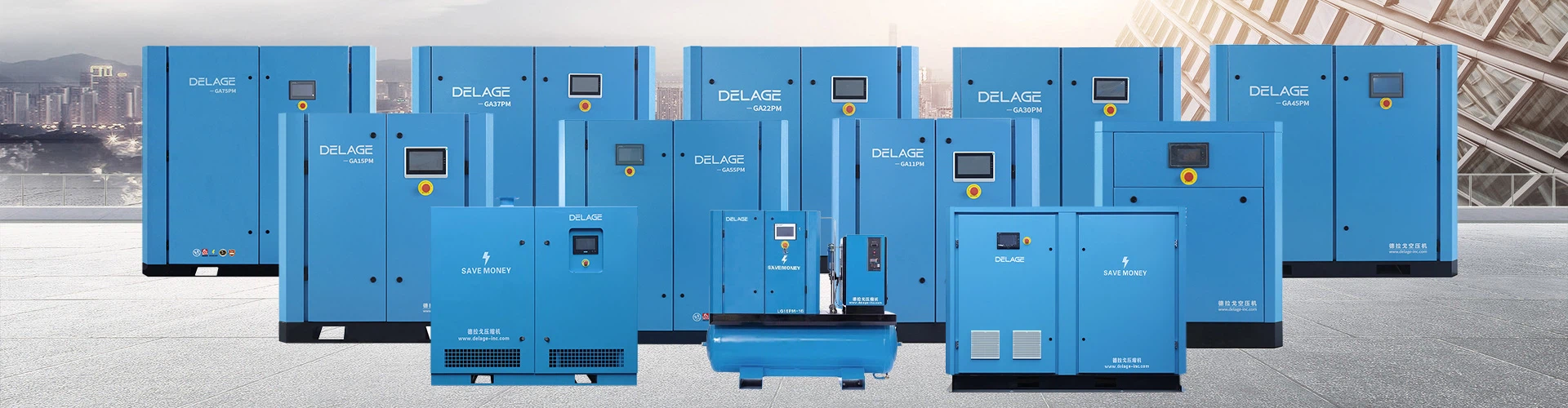
Zhejiang Delage Machinery Compressor Co., Ltd. (referred to as "Delage Machinery" or "Delage Air Compressor") was established in 2013 and is located at No. 1, Gongqu District 1, Chang'an Town, Haining, Jiaxing City, Zhejiang Province (close to Hangzhou and Shanghai), covering an area of approximately 6,398 square meters, and has built a standardized factory building of approximately 15,000 square meters.The company is mainly engaged in the manufacturing and processing of air compressors, power savers and accessories; the wholesale of air compressors and supporting equipment, energy-saving products and supporting equipment, Wujinjiaodian, building decoration materials, plumbing equipment, filtration and purification equipment and accessories, lubricating oil, Retail; repair, maintenance, and leasing services of air compressor equipment and supporting equipment, energy-saving products and supporting equipment; technology development, technical consultation, technology transfer, and technical services in the field of energy saving; engaged in the import and export business of various commodities and technologies (National Except for those restricted or prohibited; except for those involving pre-approval), etc. Products have been widely used in textile, medicine, aerospace, cement, food and other industries.
Our Certificates


FAQ
Q: What happens if you run a vacuum pump without oil?
Q: How do oil free vacuum pumps work?
Q: How important is oil in a vacuum pump?
Q: Are oil vacuum pumps better than oil free?
Q: Do all vacuum pumps need oil?
Q: Do vacuums need oil?
Q: What is an oil-free pump?
Q: What is the difference between oil-free pump and oil pump?
Q: What happens if vacuum pump has too much oil?
Q: Why does a pump need oil?
Q: How often should vacuum pump oil be changed?
A common question for vacuum pump owners is, “How often should you change the oil on a vacuum pump?” It is an excellent question and reminds us that periodic maintenance keeps your equipment operating at optimal performance and extends the life of your pump. We recommend every 500 hours.
Q: How much oil should be in a vacuum pump?
Q: Which oil is best for vacuum pump?
Q: Does vacuum pump oil evaporate?
Q: What is vacuum pump oil made of?
Q: What happens to oil in a vacuum?
Q: Why do vacuums need filters?
Q: Is oil free good?
Q: Do I need oil free?
Q: Why use an oil free compressor?
End products and uses will have significantly less oil condensate. Any industries with sanitary requirements, such as Food & Beverage and Pharmaceutical manufacturing, would be better off utilizing oil free compressors for their facilities.
We're professional oil free vacuum pump manufacturers and suppliers in China, specialized in providing high quality custom service. We warmly welcome you to wholesale high-grade oil free vacuum pump made in China here from our factory.
Oil Free Pump, Oil Free Vacuum Pump, Oilless Pump