

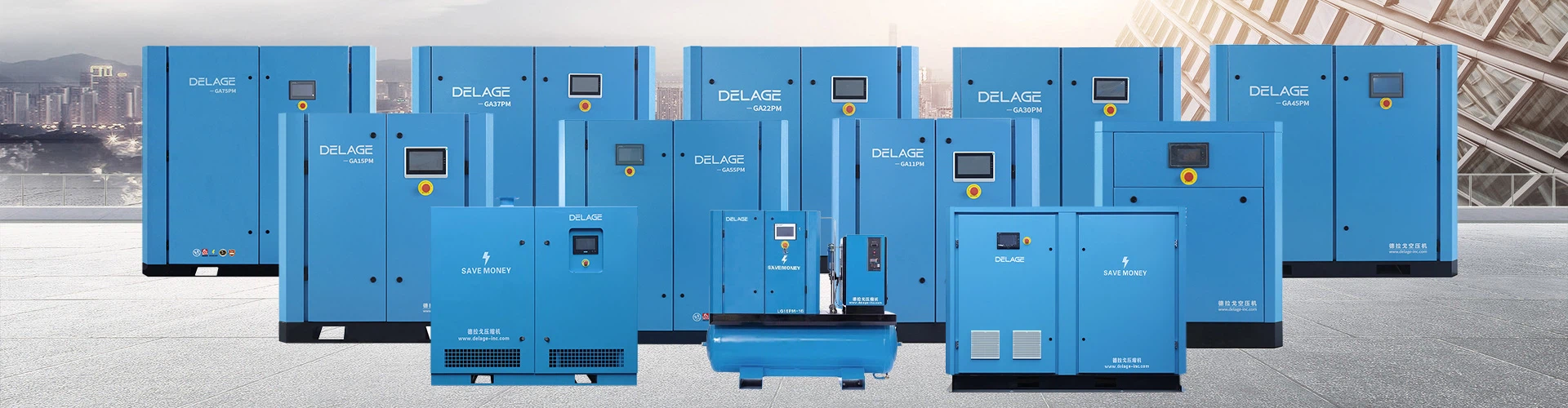
The screw air compressor and the centrifugal air compressor are two distinct types of compressors that are widely used in various industrial applications. While both serve the purpose of compressing air or gas, they differ significantly in their design, operating principles, performance characteristics, and areas of application. This article aims to delve into these differences, highlighting the key distinctions between the two types of compressors.
This type of compressor operates on the principle of positive displacement, relying on the meshing of two helical screws (male and female rotors) to trap and compress air within the compressor housing. As the rotors rotate, they reduce the volume of the trapped air, thereby increasing its pressure. Screw compressors are typically known for their ability to produce a continuous flow of compressed air with relatively high pressure ratios. They are also relatively compact and easy to install, making them suitable for a wide range of applications.
On the other hand, the centrifugal air compressor operates on the principle of kinetic energy conversion. It uses a rotating impeller to accelerate the air entering the compressor. As the air passes through the impeller, it gains velocity and is then directed into a diffuser where its velocity is converted into pressure. Centrifugal compressors are known for their high efficiency, especially at higher flow rates and pressures. They are also well-suited for applications that require a large volume of compressed air, such as large-scale industrial processes or power generation systems.
One of the key differences between the two compressors lies in their efficiency. Centrifugal compressors tend to be more efficient at higher flow rates and pressures, while screw compressors may offer better efficiency at lower flow rates. This is due to the different operating principles of the two types of compressors. Centrifugal compressors rely on the kinetic energy of the rotating impeller to compress the air, which becomes more efficient as the flow rate and pressure increase. In contrast, screw compressors use positive displacement to compress the air, which may result in higher friction losses at higher flow rates.
Another difference between the two compressors is their noise level. Screw compressors tend to be louder than centrifugal compressors due to the mechanical interaction of the rotors and the high-pressure pulses generated during compression. Centrifugal compressors, on the other hand, operate more smoothly, resulting in lower noise levels. This can be an important consideration in applications where noise pollution is a concern.
Screw compressors may require more frequent maintenance due to the wear and tear of the rotors and bearings. Centrifugal compressors, on the other hand, typically have fewer moving parts and require less frequent maintenance. However, it's worth noting that the maintenance needs of a compressor depend heavily on its specific design, operating conditions, and manufacturer's recommendations.
In terms of application, screw compressors are often used in smaller-scale operations that require continuous airflow with moderate pressure. They are commonly found in workshops, garages, and smaller industrial settings. On the contrary, centrifugal compressors are more often employed in large-scale industrial processes, power plants, and other high-capacity applications that demand high-pressure, high-volume airflow.
The initial cost of the two compressors can also vary. Generally, screw compressors may have a lower initial cost compared to centrifugal compressors, making them more accessible for smaller businesses or operations with limited budgets. However, the long-term cost-effectiveness of a compressor should also consider its operating efficiency, maintenance costs, and lifespan.
The screw air compressor and the centrifugal air compressor differ significantly in their design, operating principles, performance characteristics, and areas of application. Understanding these differences is crucial for selecting the most suitable compressor for a particular application. While both types of compressors have their advantages and disadvantages, a careful analysis of the specific requirements and operating conditions will help determine the best choice for the job.


